How Do You Manage Time in a Design Exam Hall?
Share
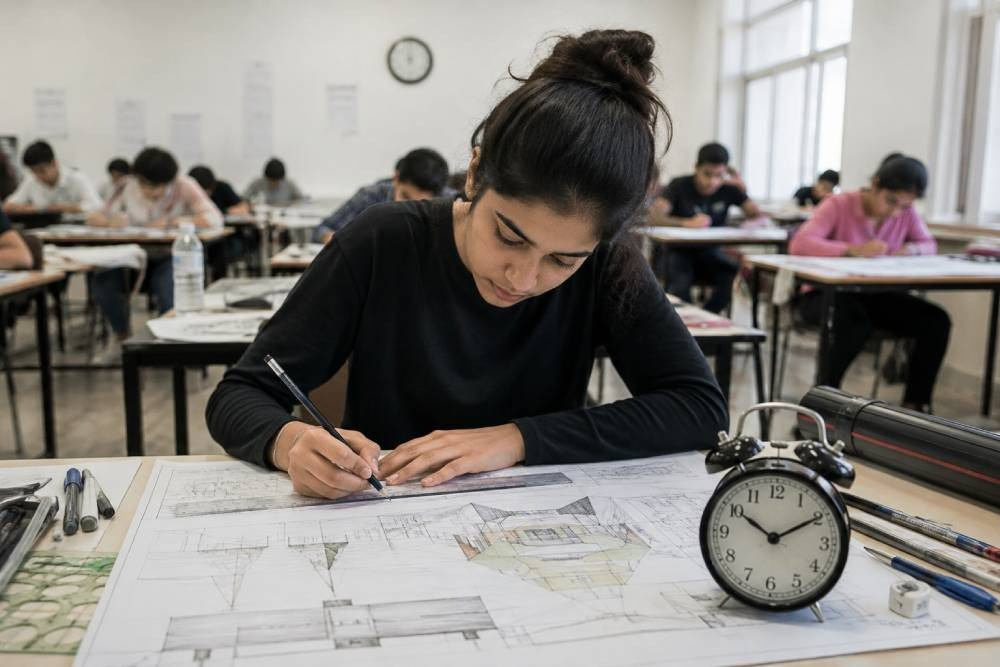
To manage your time effectively during a design exam, first understand the brief, decide what you want to communicate, and plan your drawing before committing to the final execution. Divide your available time among ideation, execution, refinement, and review, while prioritising the elements that convey your main idea.
The key is not to make every part of your drawing highly detailed. Complete the essential visual communication first, then refine it if time allows. If one drawing is taking longer than expected, recognise when the idea is clear enough to move forward instead of allowing one answer to consume the time needed for the rest of your work.
Regular timed drawing exercises can help you identify where you lose time and develop the ability to make faster, more deliberate creative decisions.
Why Time Management Matters in a Design Exam
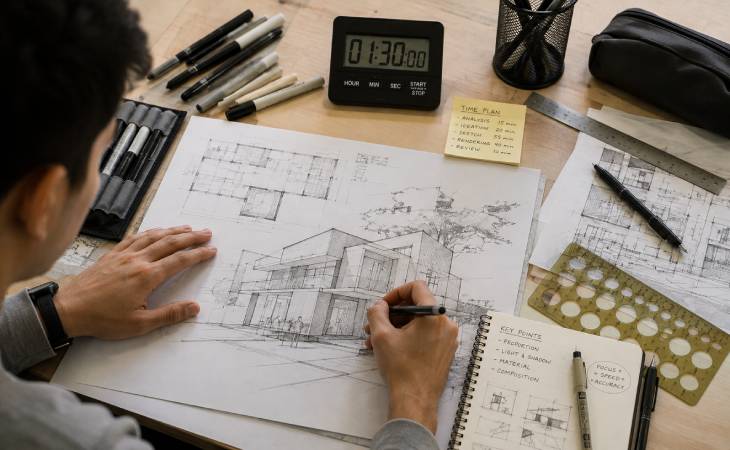
A design exam is not simply a test of how well you can draw. You may need to understand a brief, develop an idea, decide what to communicate, compose the visual and present your response all within a limited amount of time.
This makes time management a creative skill as much as an organisational one.
When you have unlimited time, you can keep changing an idea, correcting small imperfections or adding more detail. In an exam hall, however, every extra minute spent on one part of a drawing reduces the time available for the rest of your work.
The goal is therefore not to draw as quickly as possible. It is to make intelligent decisions about where your time will have the greatest impact.
1. Understand the Brief Before You Start Drawing
One of the easiest ways to lose time is to begin sketching before understanding what the task requires.
Before putting your pencil to paper, identify:
- What exactly do you need to communicate?
- What are the essential elements of the response?
- Is there a particular situation, object, character, space or idea you need to show?
- Does the response require labels, annotations or an explanation?
- Which parts of the task are likely to require the most thought or execution time?
This short planning stage can prevent you from developing an idea that does not fully answer the brief.
Keep Planning Brief and Purposeful
Planning should help you start not delay you.
You do not need to search for the perfect idea. Aim to identify a clear, relevant and achievable concept that you can develop within the available time.
2. Plan Your Drawing Before the Final Execution
Starting directly with the final drawing can lead to unnecessary erasing, changes in composition and unfinished work.
Instead, create a quick mental plan or thumbnail sketch.
Consider:
- Overall composition
- Main focal point
- Placement of important elements
- Proportions and perspective
- Visual hierarchy
- Essential details
- Areas that can be simplified
A quick thumbnail can help you test the overall structure before investing time in the final drawing.
The purpose is not to create another finished drawing. It is to make the final drawing easier and more efficient to execute.
3. Divide Your Time Into Four Stages
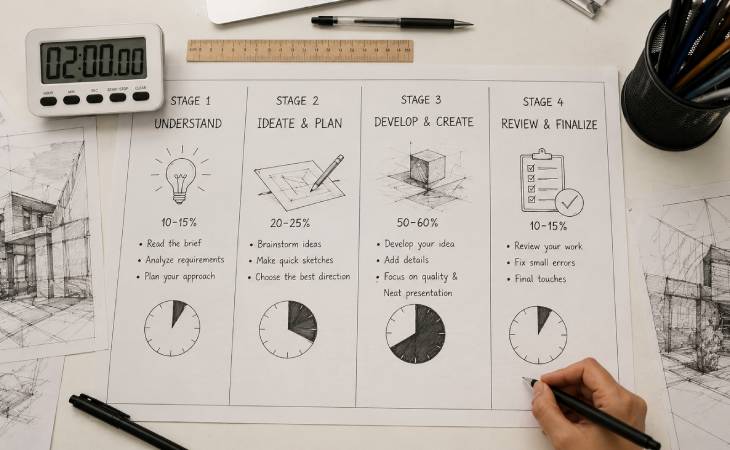
Instead of thinking about the exam as one long drawing session, break your working process into four stages.
| Stage | What to focus on | What to avoid |
|---|---|---|
| Ideation | Understand the brief and choose a workable concept | Searching endlessly for the perfect idea |
| Execution | Establish composition, major forms and important visual elements | Detailing before the structure is clear |
| Refinement | Improve areas that strengthen clarity and presentation | Reworking every small imperfection |
| Review | Check whether the response is complete | Using the final minutes only for decoration |
This approach helps prevent a common problem: spending most of your available time on one part of a drawing and having little time left to complete the overall response.
4. Prioritise What Matters Most in Your Drawing
Not every element of a drawing deserves the same amount of time.
Think about your response in layers of importance:
First: Communicate the idea
The viewer should be able to understand what you are trying to show.
Second: Establish the composition
The major elements should be positioned clearly and work together.
Third: Build the important forms
Make sure the key objects, characters, spaces or visual elements are established.
Fourth: Add supporting details
Use details that strengthen the concept or improve visual communication.
Finally: Refine
Add finishing touches only when the essential work is already complete.
This prioritisation helps you avoid a common time-management problem: one highly detailed section surrounded by an unfinished drawing.
5. Know When to Move On From a Drawing
One of the hardest decisions during a design exam is knowing when a drawing is finished enough.
Ask yourself:
Does this drawing communicate my idea clearly enough for me to move forward?
If the answer is yes, consider moving to the next task.
You do not need to eliminate every small imperfection before continuing. If another few minutes will only create a minor visual improvement but could help you complete another important part of the exam, that time may be better spent elsewhere.
This does not mean submitting careless work. It means understanding the difference between necessary refinement and unnecessary perfectionism.
6. Avoid Spending Too Much Time on Details
Details can make a drawing more visually appealing, but they should support the idea rather than become the focus of your time.
Be careful about spending too long on:
- Repeated erasing
- Redrawing elements that are already clear
- Tiny decorative details
- Excessive shading
- Perfecting minor proportions
- Detailing areas that are not central to the concept
Instead, ask:
Does this detail improve the communication of my idea?
If it does, keep it.
If it does not, move on.
Good time management is often about knowing what not to spend time on.
7. What to Do When One Drawing Takes Longer Than Expected
Sometimes a drawing simply takes longer than planned. The important thing is not to let one difficult task disrupt the rest of your work.
If you realise you are falling behind:
| Situation | What to do |
|---|---|
| You are still changing your idea | Commit to the strongest workable concept |
| You are over-detailing | Stop refining non-essential areas |
| Major elements are missing | Complete them before adding details |
| Another task is still untouched | Move forward if the current response is sufficiently clear |
| You have very little time left | Prioritise completion and essential corrections |
The objective is to recover your schedule rather than panic about the time already lost.
A few lost minutes do not have to turn into a completely unfinished response.
8. Keep a Time Buffer
Avoid planning to use every available minute for drawing.
Leave some room for:
- Unexpectedly difficult tasks
- Changes to an idea
- Corrections
- Completing unfinished elements
- Reviewing the overall response
A time buffer gives you flexibility when something takes longer than expected.
Without one, even a small delay early in the exam can create unnecessary pressure during the final minutes.
9. Use the Final Minutes for Completion, Not Decoration
When you are close to the end, resist the temptation to keep polishing the drawing you are currently working on.
Instead, quickly review the overall work.
Ask yourself:
- Is any important drawing incomplete?
- Have I communicated the main idea in each response?
- Are any major elements missing?
- Are required labels or explanations complete?
- Is there anything that can be corrected quickly?
- Am I still spending time on details that are no longer essential?
At this stage:
Completion should take priority over decoration.
A finished and clearly communicated response is more useful than a beautifully detailed section that leaves the overall work incomplete.
10. Practise Time Management Before the Design Exam
Time management improves through practice not simply by deciding to “draw faster” on exam day.
Try timed drawing exercises during your preparation.
You can practise:
- Developing a concept within a fixed time
- Creating quick thumbnail sketches
- Completing a composition within a set duration
- Simplifying a complex scene
- Drawing the same subject with different levels of detail
- Finishing a response with time reserved for review
The objective is not just to increase drawing speed.
You are training yourself to make faster and more deliberate creative decisions.
11. Review Where You Lose Time
After completing a timed drawing exercise, do not only evaluate the finished artwork. Evaluate your process.
Ask yourself:
- Did I spend too long thinking of an idea?
- Did I keep changing my concept?
- Did I start drawing before understanding the composition?
- Did I erase more than necessary?
- Did I spend too much time on details?
- Which part of the drawing remained unfinished?
- What could I simplify next time?
Different students lose time for different reasons.
For one student, the issue may be overthinking. For another, it may be excessive detailing or repeated corrections.
Once you understand where your time goes, you can start managing it deliberately.
Time Management Is Part of Creative Intelligence
Design is not only about generating ideas; it is also about knowing how to develop them into clear solutions within constraints.
In a time-limited design task, you have to decide what matters, what can be simplified and when an idea is ready to move forward. These are creative decisions, not just time-management decisions.
This connects with Creative Intelligence, a key part of École Intuit Lab’s approach to design education. Through practical learning, experimentation and project-based work, students learn to develop ideas while responding to constraints.
Students interested in exploring different design disciplines can explore École Intuit Lab’s design programmes, spanning visual communication, digital product design, game art and design, animation and motion design, retail and interior design, advertising, creative technology and experiential design.
The Goal Is Not to Draw Faster It Is to Make Better Decisions
Managing your time in a design exam is not about drawing faster. It is about understanding the brief, making deliberate creative choices, prioritising what matters and knowing when to move forward.
When you practise timed drawings, ask yourself not only, “How good does my drawing look?” but also, “Did I use my time intelligently?”
Learning to balance creativity with time constraints can help you turn your ideas into complete, clearly communicated visual responses instead of unfinished drawings.
If you are exploring design as a field of study after school, read What Is the Scope of Design Courses After 12th? to understand the broader possibilities across design disciplines.
FAQs
1. What should I do if my first drawing idea is not working?
Don’t spend too long trying to fix an idea that isn’t developing. Simplify it or make a practical change and move forward.
2. How can I stay calm when I realise I am behind on time?
Focus on what you can still complete rather than the time you’ve lost. Prioritise the essential elements and work through them one at a time.
3. Is rough work useful during a design exam?
Yes, a quick thumbnail can help you test composition, proportions and placement before starting the final drawing. Keep it brief and purposeful.
4. How can I improve my drawing speed without making my work careless?
Practise making quicker creative decisions rather than simply drawing faster. Timed exercises can help you learn what to simplify and where to focus your effort.
5. How do I know whether I am overworking a drawing?
If your main idea is already clear and you’re only making minor improvements, it may be time to move on. Use that time to complete another important part of your response.


